Every transformative technology begins with a familiar paradox: at the moment of its creation, humans become extraordinarily expensive.
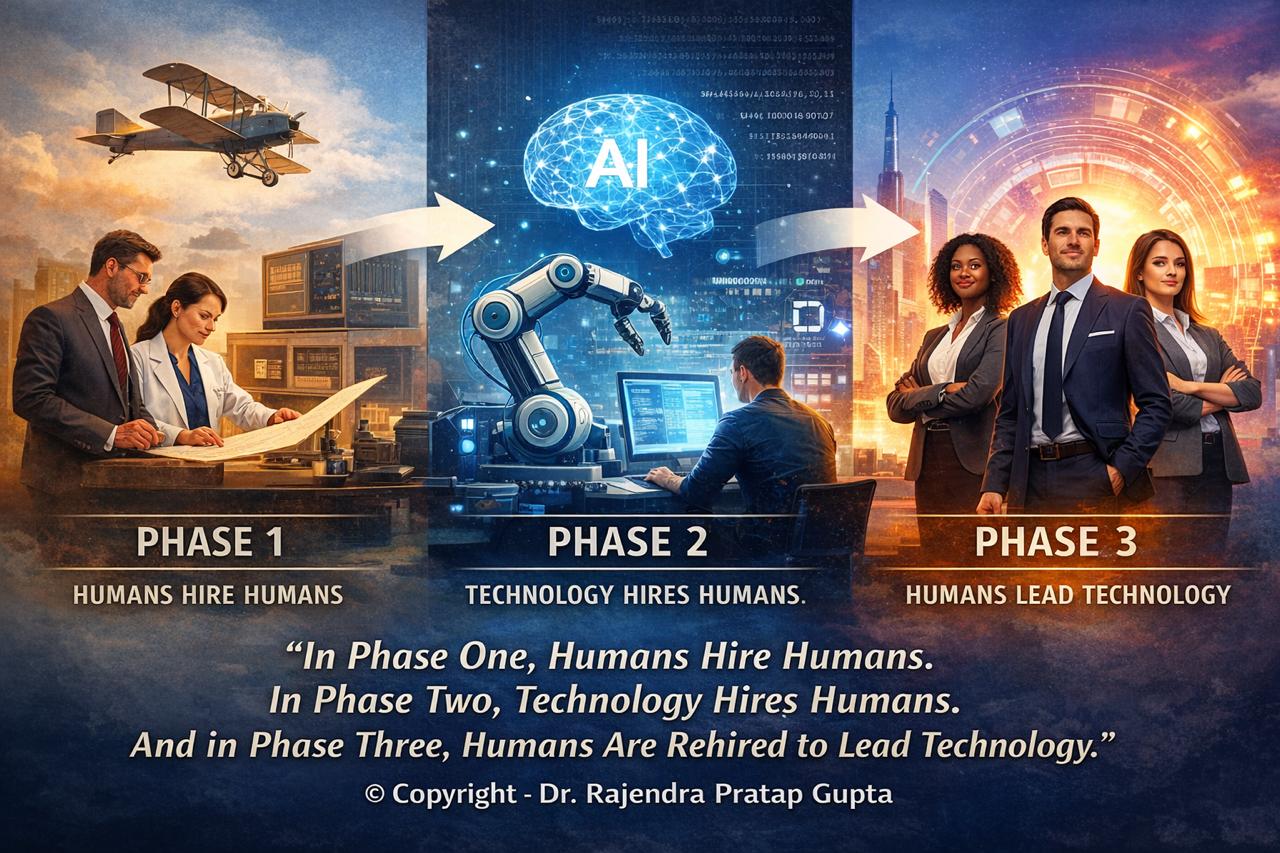
In the early days of aviation, pilots were heroes and engineers were magicians. Flying demanded intense human skill, judgment, and courage. Technology was fragile; humans were invaluable. The same was true of early computing, when programmers were mathematicians and machines occupied entire rooms. Human intelligence was the bottleneck, so humans commanded premium value.
This is Phase One of every technology cycle: humans are expensive because technology cannot exist without them.
Then comes the inevitable shift.
Technology begins to create technology.
Tools improve, abstractions emerge, and complexity gets hidden behind interfaces. What once required a team of experts can now be done by one person, and soon, by a system. Efficiency scales. Costs fall. And gradually, humans who once defined value begin to look interchangeable.
This is Phase Two, the most unsettling phase-where humans appear cheap. Jobs are automated, skills are commoditized, and experience depreciates faster than ever before. We are living through this phase right now with AI. It is not a failure of people; it is a feature of maturing technology- thanks to humans !
The Human Returns!
But history shows us that the story does not end with replacement. It ends with rehiring.
When technology reaches a certain level of maturity, it discovers its own limitations. Machines optimize brilliantly, but they do not imagine. They execute flawlessly, but they do not judge consequences. They predict patterns, but they do not understand purpose. Fully autonomous systems eventually run into risks—ethical blind spots, contextual failures, and misaligned incentives.
That is when humans return- by design.
This is Phase Three: the return of the Human-in-the-Loop.
“In Phase One, humans hire humans. In Phase Two, technology hires humans. And in Phase Three, humans are rehired to lead technology.” But not all humans return equally.
The first to be rehired, and the last to be fired, are not those who merely operate technology. They are the creators, the innovators, and the leaders whose imagination moves faster than technology itself. These are people who don’t ask, What can this tool do? but What should we do with it? They see around corners, connect disciplines, and make decisions when data runs out.
Technology never replaces imagination. It amplifies it.
That is why the future belongs to leaders who can think beyond tools, understand systems, and translate technology into real-world value. In every cycle—from aviation to medicine to AI; the winners are not the best users of technology, but the best thinkers about technology.
This is exactly the gap we are addressing through our work at the Academy of Digital Health Sciences.
Our focus is not just on teaching digital tools, but on building digital leaders—professionals who understand how technology reshapes healthcare, policy, organizations, and society. Leaders who can sit confidently in the Human-in-the-Loop role, guiding systems with insight, ethics, and imagination.
Because when the cycle completes, and it always does- the question is not whether humans will be back in the loop.
The real question is: will you be one of the humans technology chooses to rehire?
Dr. Rajendra Pratap Gupta, PhD
Academy of Digital Health Sciences
#humancentredAI #AI #ArtificialIntelligence #digitalhealthLeaders #LeadersinTech #womenintech #techleaders #digitalhealthcourses #innovation #disruption #change #hospitals #abdm National Health Authority (NHA) Academy of Digital Health Sciences Health Parliament World Health Organization United Nations